


 How to
Use
How to
Use


- Health & Beauty Protective Items Health & Medical Beauty & Personal Care
- Bags, Shoes & Accessories Luggage, Bags & Cases Shoes & Accessories
- Apparel, Textiles & Accessories Apparel Textile & Leather Product Fashion Accessories Timepieces, Jewelry, Eyewear
- Electronics Industrial Computer & Accessories Home Appliance Consumer Electronic Security & Protection
- Electronic Equipment, Component & Telecoms Electronic Equipment & Supplies Telecommunication
- Home, Lights & Construction Construction & Real Estate Home & Garden Lights & Lighting Furniture
- Gifts, Sports & Toys Gifts & Crafts Toys & Hobbies Sports & Entertainment
- Agriculture & Food Agriculture Food & Beverage
- Auto & Transportation Automobiles & Motorcycles Transportation
- Machinery, Industrial Parts & Tools Machinery Industrial Parts & Fabrication Services Tools Hardware Measurement & Analysis Instruments
- Metallurgy, Chemicals, Rubber & Plastics Minerals & Metallurgy Chemicals Rubber & Plastics Energy Environment
- Packaging, Advertising & Office Packaging & Printing Office & School Supplies Service Equipment
- K-Service Innotech Contents ICT Technology/Engineering
- ETC ETC




ITEM SPECIFICS
-
Brand
Model Wind Tunnel Test for BridgesTESolution
-
origin
Republic of Korea
-
Size(Capacity)
Customized product
-
Function
Understanding the aerodynamic characteristics of bridges using wind tunnels
-
Material
Customized
-
Style
-
-
Expiry Date
Customized
PRODUCT DESCRIPTION
Wind Tunnel Test for Bridges
Our bridge wind tunnel testing services are broadly classified into three major types, detailed below along with their primary objectives and scopes.
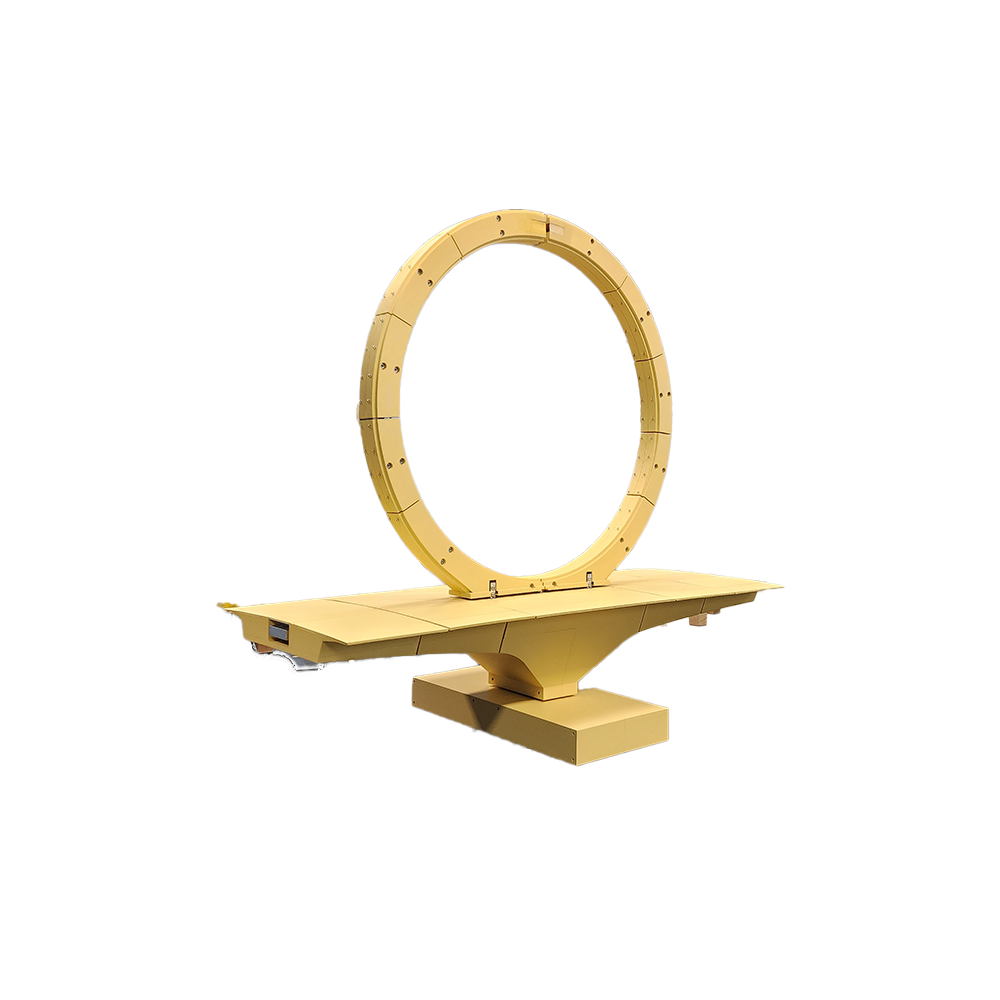
1. Section Model Test
· Objective : Conducted to evaluate the aerodynamic stability of the bridge. It serves as the most fundamental, critical, and cost-effective testing methodology.
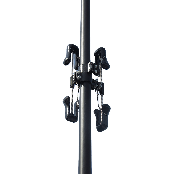
· Scope : This test utilizes a rigid model representing a typical two-dimensional section of structures with high two-dimensional characteristics, such as bridge girders, cables, and pylons. In evaluating a bridge’s aerodynamic stability, it is the most essential and cost-effective method. Section model testing includes: free vibration tests, which simulate dynamic properties using a spring support system; aerodynamic tests, which measure drag, lift, and moment coefficients using a 3-component load cell; and forced vibration tests, which utilize specialized forced-vibration rigs to measure unsteady aerodynamic forces that induce dynamic structural responses. Through these tests, critical parameters of aerodynamic stability are verified, and the implementation of aerodynamic countermeasures—such as fairings and flaps—is determined.
· Key Deliverables : Dynamic aerodynamic stability (onset wind speeds and amplitudes of vortex-induced vibration, flutter, galloping, etc.), aerodynamic force coefficients (drag, lift, and moment coefficients), etc.
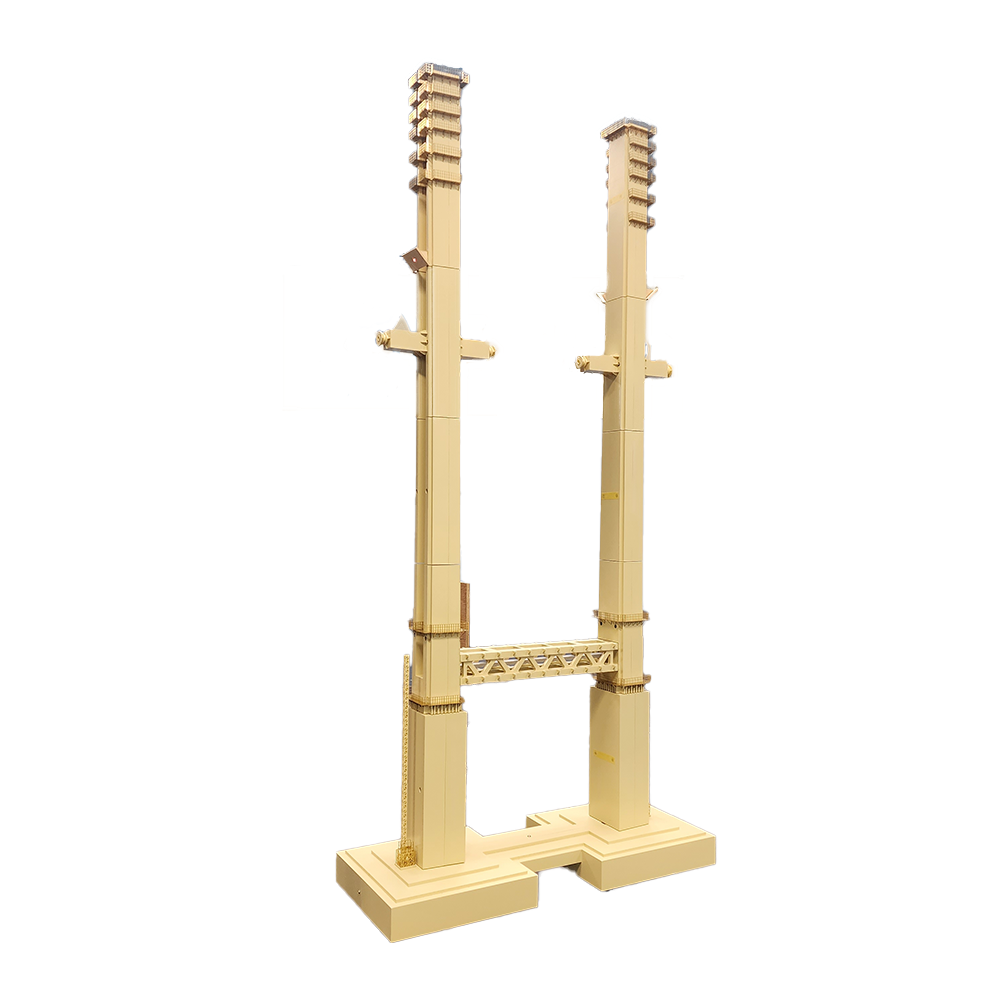
2. Pylon Model Test
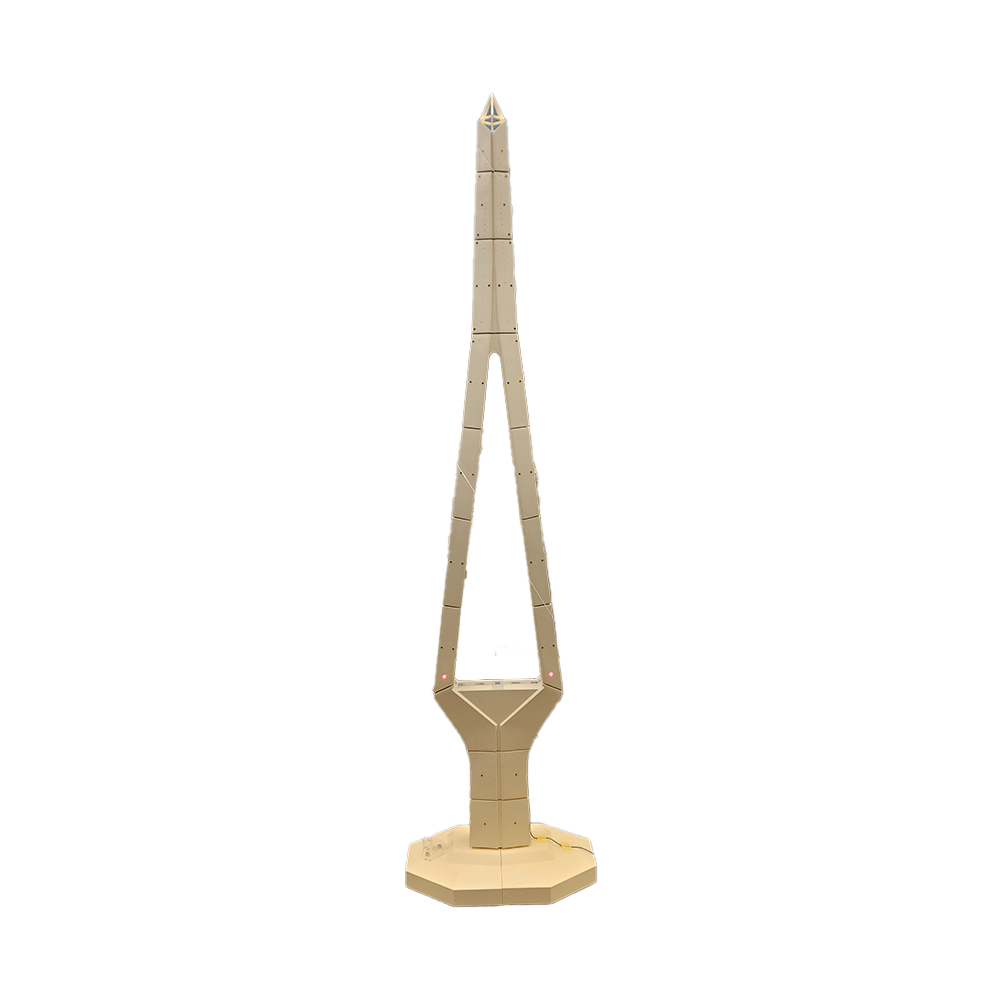
· Objective : Includes aeroelastic model tests and aerodynamic force tests on bridge pylons at various construction phases, primarily conducted to evaluate the aerodynamic stability of isolated pylons.
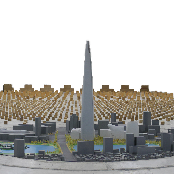
· Scope : Pylons of cable-stayed and suspension bridges have significantly higher slenderness ratios compared to typical buildings, demanding meticulous evaluation against wind loads. In particular, the isolated pylon stage prior to cable tensioning exhibits lower structural damping than the post-tensioned state, making it far more vulnerable to vibration issues. Aeroelastic model tests for pylons utilize an elastic model that replicates the pylon's dynamic properties (mass, frequency, damping, mode shapes, etc.). Separately, when calculating the design wind loads acting on the pylon, aerodynamic tests are conducted using either a full rigid model of the entire pylon or a partial section model of the pylon leg.
· Key Deliverables : Dynamic aerodynamic stability (onset wind speeds and amplitudes of vortex-induced vibration, galloping, etc.), base shear force, base overturning moment, base torsional moment, etc.
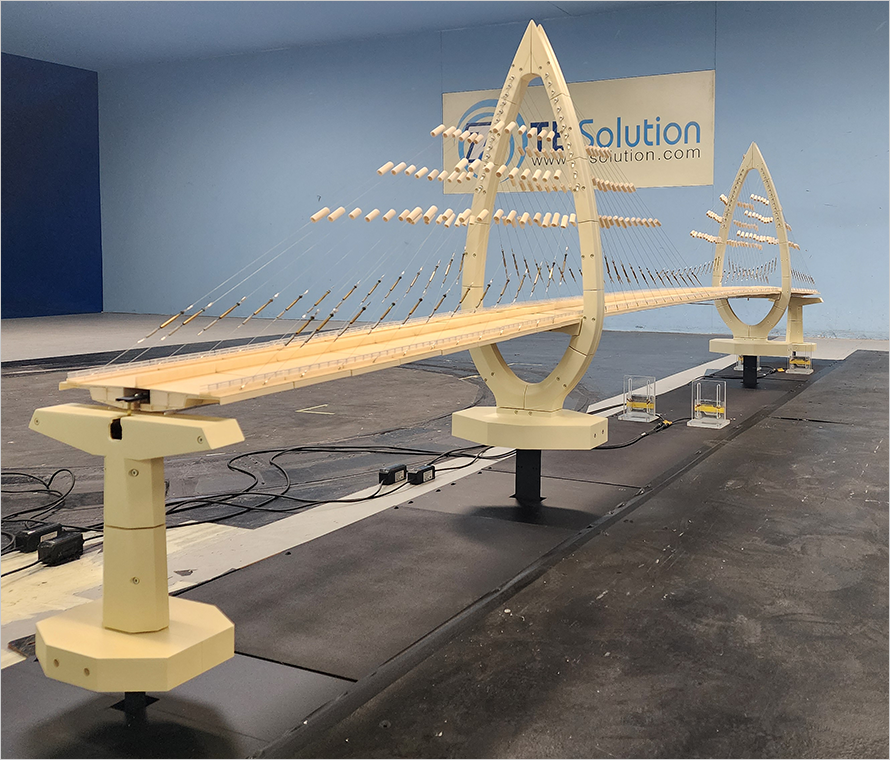
3. Full Bridge Model Test
· Objective : Because the aerodynamic behavior of a bridge is shaped by the complex interaction of the girder, pylons, and cables—as well as the surrounding terrain—a full bridge test is required for precise analysis. In particular, a 3-dimensional aerodynamic stability review is essential during the erection (construction) stages, as the structural dynamic properties constantly evolve.
· Scope : The actual aerodynamic behavior of a bridge manifests through the coupled dynamic properties of the girder, pylons, and cables. Furthermore, due to surrounding topographical features, bridges are often subjected to wind loads from skewed angles (non-perpendicular to the bridge axis). For bridges where the girder cross-section varies along the bridge axis, vibrations that are difficult to predict via 2D section model tests can occur. In such cases, it is highly recommended to perform wind tunnel testing by modeling the entire bridge. The erection stages, in particular, exhibit dynamic properties entirely different from the completed stage; as construction progresses, these properties change continuously, necessitating a thorough assessment of 3D dynamic aerodynamic stability. Similar to pylon testing, full bridge vibration tests utilize a 3-dimensional aeroelastic model that exhibits true elastic behavior.
· Key Deliverables : Dynamic aerodynamic stability of the girder and pylons (onset wind speeds and amplitudes of vortex-induced vibration, flutter, galloping, buffeting, etc.), aerodynamic stability verification for each construction stage, etc.
About Us
Our compnay was established in February 2001, with the goal to provide greater life to our clients through our accurate evaluation of safety and serviceability of various structures and our solutions to improve them, based on our differentiated technical expertise and accumulated experience in the field of Wind Engineering and Vibration Control.
As to the field of Wind Engineering, TESolution provides solutions for safer and better life with evaluation on serviceability of buildings and bridges through wind resistance stability tests and wind induced vibration tests, and evaluation on wind environment through wind environment assessment techniques, all based on our highest level of expertise and technically advanced wind test facilities.
As to the field of Vibration Control, TE Solution provides solutions to improve the quality of living environment through our vibration control devices that reduce or suppress the vibration occurred from wind load, seismic load, or traffic load on various structures.
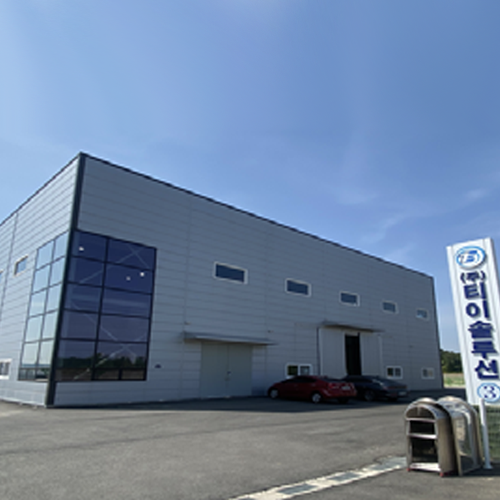
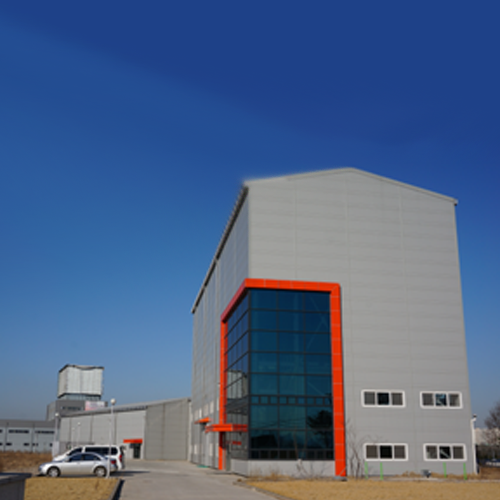
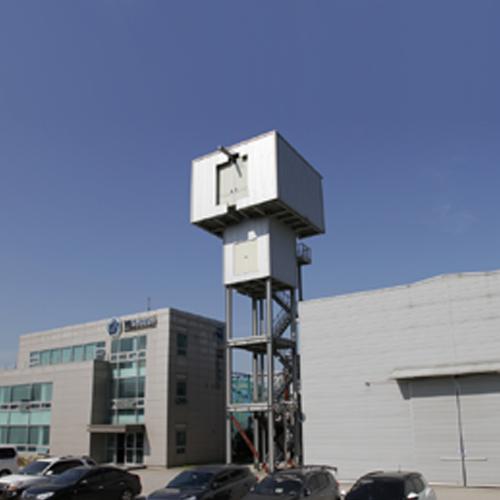
With the support of our clients we were able to launch our subsidiary, TE Solution has established its company building with Mid-sized 2D Wind Tunnel that is bigger than that of TE
Solution’s. Also, our vibration control technology has been gaining recognition internationally, and the number of our projects in Southeast Asia, East Asia, and Europe have been steadily increasing.
We thank our customers again for your continuous support, and we promise our very best to provide satisfactory results through our highest technical expertise and continuous R&D efforts.
As to the field of Wind Engineering, TESolution provides solutions for safer and better life with evaluation on serviceability of buildings and bridges through wind resistance stability tests and wind induced vibration tests, and evaluation on wind environment through wind environment assessment techniques, all based on our highest level of expertise and technically advanced wind test facilities.
As to the field of Vibration Control, TE Solution provides solutions to improve the quality of living environment through our vibration control devices that reduce or suppress the vibration occurred from wind load, seismic load, or traffic load on various structures.
With the support of our clients we were able to launch our subsidiary, TE Solution has established its company building with Mid-sized 2D Wind Tunnel that is bigger than that of TE
Solution’s. Also, our vibration control technology has been gaining recognition internationally, and the number of our projects in Southeast Asia, East Asia, and Europe have been steadily increasing.
We thank our customers again for your continuous support, and we promise our very best to provide satisfactory results through our highest technical expertise and continuous R&D efforts.
Other Products
R&D CERTIFICATE
-
- ISO14001
- Korea Employers' Federation Certification Register
- 2025.09.26
- 인증서보기
-
- ISO9001
- Korea Employers' Federation Certification Register
- 2025.09.26
- 인증서보기
-
- ISO45001
- Certification Partner Global
- 2025.03.26
- 인증서보기
-
- Certificate of Inno-Biz
- Minisry of SMEs and Startups
- 2026.12.09
- 인증서보기
-
- Certificate of Product-Specific Approved Exporter
- Korea Customs Service
- 2025.08.11
- 인증서보기
PAYMENTS DETAILS
This supplier supports payments for offline orders
- Telegraphic Transfer : T/T
- Name : YOUN SEOK KIM
SHIPPING
Shipping from :
Republic of Korea
- 142 Seungjin-gil Gongdo-eup, Anseong-si, Gyeonggi-do (17563)
TESolution Co., Ltd.
The person in charge
Youn Seok KimAddress
142 Seungjin-gil Gongdo-eup, Anseong-si, Gyeonggi-do (17563)
Introduction
Our compnay was established in February 2001, with the goal to provide greater life to our clients through our accurate evaluation of safety and serviceability of various structures and our solutions to improve them, based on our differentiated technical expertise and accumulated experience in the field of Wind Engineering and Vibration Control.
As to the field of Wind Engineering, TESolution provides solutions for safer and better life with evaluation on serviceability of buildings and bridges through wind resistance stability tests and wind induced vibration tests, and evaluation on wind environment through wind environment assessment techniques, all based on our highest level of expertise and technically advanced wind test facilities.
As to the field of Vibration Control, TE Solution provides solutions to improve the quality of living environment through our vibration control devices that reduce or suppress the vibration occurred from wind load, seismic load, or traffic load on various structures.
With the support of our clients we were able to launch our subsidiary, TE Solution has established its company building with Mid-sized 2D Wind Tunnel that is bigger than that of TE Solution’s. Also, our vibration control technology has been gaining recognition internationally, and the number of our projects in Southeast Asia, East Asia, and Europe have been steadily increasing.
We thank our customers again for your continuous support, and we promise our very best to provide satisfactory results through our highest technical expertise and continuous R&D efforts.
-
- Business Type :
- Manufacturer
-
- Main Product :
- Wind Tunnel Test for Bridges
-
- Established :
- 2001-02-01
-
- Total Annual Revenue :
- Less than 100 million (KRW)
-
- Total Employees :
- 11~50 people
R&D CERTIFICATE
-
- ISO14001
- Korea Employers' Federation Certification Register
- 2025.09.26
- 인증서보기
-
- ISO9001
- Korea Employers' Federation Certification Register
- 2025.09.26
- 인증서보기
-
- ISO45001
- Certification Partner Global
- 2025.03.26
- 인증서보기
-
- Certificate of Inno-Biz
- Minisry of SMEs and Startups
- 2026.12.09
- 인증서보기
-
- Certificate of Product-Specific Approved Exporter
- Korea Customs Service
- 2025.08.11
- 인증서보기
COMPANY ENVIRONMENT
Please suggest a variety of your ideas such as design, impact, enhancements, etc
Captcha Required
Please enter the text on the left image to prevent automatic input.
0 / 4000
질문이 없습니다.
CUSTOMER REVIEWS (0)

TRADE EXPERIENCE
-
- Total revenue
- Less than 100 million (KRW)
-
- Total export revenue (previous year in USD)
- 65
-
- Number of foreign trade employees
- 11~50 people
COMPARISON TO SIMILAR ITEMS more
- No Items
- supplier level
-
 SILVER
- TESolution Co., Ltd. Seller's Store
- Seller's Store url
- Response Level
★ ★ ★ ★ ★

- Supplier Level
★ ★ ★ ★ ★
- Transaction Level
★ ★ ★ ★ ★
SUPPLIER BEST